In the Arena by Pete Hegseth
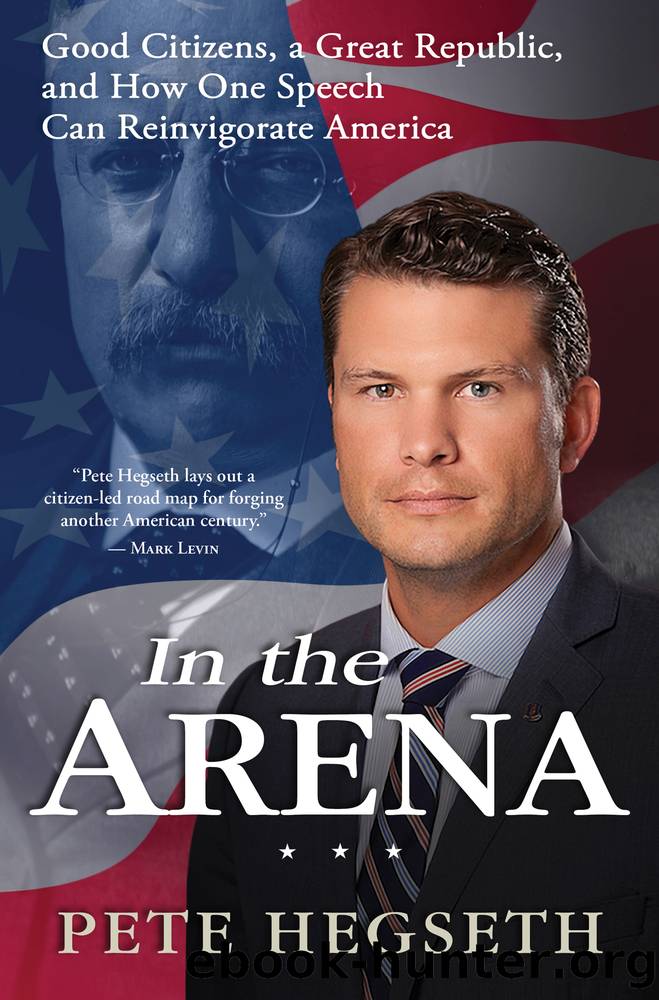
Author:Pete Hegseth
Language: eng
Format: epub
Publisher: Threshold Editions
SIX
Fight Hard: Learning the Right Lessons Since 9/11
The good citizen will demand liberty for himself, and as a matter of pride he will see to it that others receive liberty which he thus claims as his own. Probably the best test of true love of liberty in any country is the way in which minorities are treated in that country. Not only should there be complete liberty in matters of religion and opinion, but complete liberty for each man to lead his life as he desires, provided only that in so he does not wrong his neighbor. . . .
There is little place in active life for the timid good man. . . . The good citizen in a republic must first of all be able to hold his own. He is no good citizen unless he has the ability which will make him work hard and which at need will make him fight hard.
âTEDDY ROOSEVELT, 1910
How could I not work with people who came across the ocean to help save and rebuild my city?
âLITTLE OMAR, SAMARRA, IRAQ, 2006
The title of Teddy Rooseveltâs 1910 speech, âCitizenship in a Republic,â befits the content of his speech. The speech is largely about cultivating good and gutsy citizenship in order to maintain a robust and free republic. He alludes to foreign affairs only briefly, and mostly through the lens of domestic considerations. As such, nothing in the text is detailedâbut instead based on principles that were evident during his presidency and colored his eventual agitation for American involvement in World War I. In the speech Teddy references, among other principles: patriotism, national sovereignty, international engagement, freedom promotion, military strength, and having the will to fight and win when necessary. The application of these principles is the difficult partâespecially in challenging times.
Teddy Roosevelt lived in consequential times, as do we; times that challenge both the rigidity and elasticity of Americaâs core principles. Everybody is a patriot when times are good, but allegiance can fade when outcomes are murky; places like Valley Forge and the Argonne Forest remind us that commitment can be sustained, provided the public and her military are invested. International engagement is important, but not when it erodes sovereigntyâwhere is that line in an interconnected world? Promoting freedom sounds good but proves perplexing across continents and cultures. Military might and a strong posture can prevent wars, but once youâre in themâfighting to win requires mustering finite national will, clear leadership, and a reticent citizenry. National security and foreign policy have always been more of an art than a science, requiring the âwise statesmanâ Teddy Roosevelt invoked. Roosevelt also understood that statesmen are often compelled to advocate for causes and positions that, in their time, are controversial, costly, or at cross-purposes with public opinion. Public opinion in a democracy, even with an engaged citizenry, is often shortsighted, fickle, and prone to advantageous political demagoguery. Foreign policy statesmen must cut through that, while making a compelling public case as to why certain enemies, certain engagements, and certain entanglements are necessary to advance American security and interest.
Download
This site does not store any files on its server. We only index and link to content provided by other sites. Please contact the content providers to delete copyright contents if any and email us, we'll remove relevant links or contents immediately.
| Anthropology | Archaeology |
| Philosophy | Politics & Government |
| Social Sciences | Sociology |
| Women's Studies |
The Secret History by Donna Tartt(19480)
The Social Justice Warrior Handbook by Lisa De Pasquale(12297)
Thirteen Reasons Why by Jay Asher(9134)
This Is How You Lose Her by Junot Diaz(7061)
Weapons of Math Destruction by Cathy O'Neil(6485)
Zero to One by Peter Thiel(5955)
Beartown by Fredrik Backman(5952)
The Myth of the Strong Leader by Archie Brown(5632)
The Fire Next Time by James Baldwin(5592)
How Democracies Die by Steven Levitsky & Daniel Ziblatt(5335)
Promise Me, Dad by Joe Biden(5238)
Stone's Rules by Roger Stone(5196)
A Higher Loyalty: Truth, Lies, and Leadership by James Comey(5092)
100 Deadly Skills by Clint Emerson(5032)
Rise and Kill First by Ronen Bergman(4908)
Secrecy World by Jake Bernstein(4894)
The David Icke Guide to the Global Conspiracy (and how to end it) by David Icke(4854)
The Doomsday Machine by Daniel Ellsberg(4631)
The Farm by Tom Rob Smith(4614)
